


A goods lift that is still mechanically sound but visually deteriorated, operationally inefficient or simply no longer fit for purpose does not necessarily need to be replaced. A professionally planned and executed refurbishment can transform an ageing goods lift into a reliable, safe and fit-for-purpose installation at a fraction of the cost of a new lift, and with significantly less disruption to building operations.
This guide covers when goods lift refurbishment makes more sense than replacement, what a refurbishment typically involves, what it can deliver, and how to decide which approach is right for your specific lift and situation.
Goods Lift Refurbishment vs Replacement: The Core Question
The decision between refurbishing an existing goods lift and replacing it with a new installation comes down to one central question: is the existing lift’s mechanical infrastructure sound enough to justify investing in it?
If the drive system, structural components, shaft and supporting equipment are in reasonable condition and have serviceable life remaining, a car interior refurbishment, control system upgrade or modernisation of specific components can extend the operational life of the lift significantly at a much lower cost than a full replacement. If the mechanical infrastructure is genuinely at end of life, or if the lift’s capacity, speed or configuration no longer meets the building’s operational requirements, replacement is likely the more cost-effective long-term decision.
In practice, many goods lifts that look as though they need replacing actually need refurbishing. The car interior takes the most visible punishment in a working goods lift — daily impact from trolleys, pallets and heavy goods, industrial cleaning chemicals and continuous use leave interiors looking significantly worse than the mechanical components beneath them. Judging a lift by the state of its interior alone can lead to unnecessary replacement spend.
Our guide to when lift repairs stop being cost effective explores the replacement versus refurbishment decision in more depth. For goods lifts specifically, the case for refurbishment is often stronger than many building owners initially expect.
Signs Your Goods Lift Needs Refurbishment
Deteriorated car interior
The most visible sign. Peeling or cracked wall panels, damaged or missing bumper rails, worn flooring, mould or grime that cannot be cleaned, damaged ceiling panels or inadequate lighting all indicate that the car interior needs attention. Beyond aesthetics, a deteriorated interior creates practical problems: damaged panels can snag goods being loaded, inadequate lighting creates operational risks, and a lift in poor condition reflects poorly on the building and its management.
Outdated controls
Older goods lift control systems can be unreliable, difficult to source replacement parts for, and incompatible with modern building management requirements. Upgrading the control system improves reliability, enables better fault diagnosis and in many cases allows integration with building management systems.
Increasing breakdown frequency
A goods lift that is requiring increasingly frequent reactive repairs is often approaching the point where refurbishment or modernisation of specific components makes more financial sense than continued reactive spend. Our post on why reactive service lift repairs cost more in the long run covers this in detail.
Non-compliant or outdated safety systems
Older goods lifts may have safety systems that no longer meet current standards. Safety gear, overspeed governors, door interlocks and emergency communication systems all have defined lifespans and regulatory requirements. A refurbishment is an opportunity to bring safety systems fully up to current standards and ensure ongoing LOLER compliance.
The lift no longer meets operational demands
If the building’s usage has changed and the lift is no longer configured to meet operational requirements — whether that is capacity, speed, door configuration or floor levelling accuracy — a modernisation programme can address these without the cost and disruption of full replacement.
Case Study: AGA Rangemaster UK
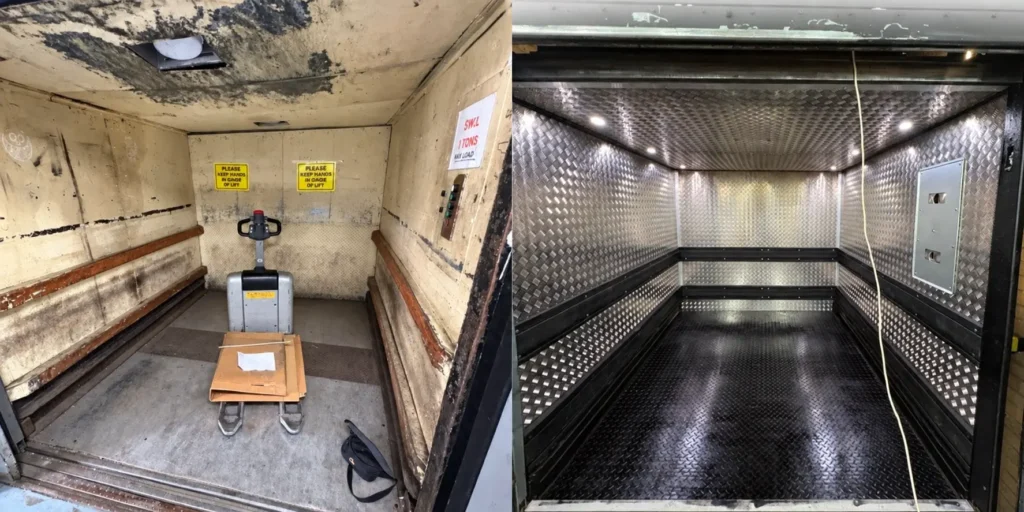
The images above show a recent goods lift refurbishment completed for AGA Rangemaster UK, one of the UK’s most recognised manufacturers of premium kitchen equipment.
The before image tells a clear story. The lift car interior had reached a state of significant deterioration after years of heavy industrial use. The cream painted wall panels were extensively cracked, peeling and covered in black mould particularly concentrated on the ceiling and upper walls. The wooden bumper rails running along both sides of the car were damaged and worn through. The lighting was inadequate for a working industrial environment and the overall condition of the interior was both visually unacceptable and practically problematic for day-to-day operations.
The mechanical infrastructure of the lift remained sound. The decision was made to carry out a full car interior refurbishment with finishes specified for heavy-duty industrial use rather than replace the lift entirely.
The after image shows the result. The entire car interior has been lined with heavy duty diamond plate aluminium chequerplate throughout — walls, ceiling and floor. This is the industry standard finish for high-use commercial and industrial goods lifts, chosen for its exceptional durability, resistance to impact damage and ease of cleaning. New recessed LED downlights have been installed in the ceiling, providing consistent, bright illumination throughout the car. New black steel bumper protection rails run along the lower walls, providing robust protection against the inevitable impacts of trolleys and pallet trucks. A new flush-mounted control panel completes the transformation.
The result is a lift that looks and performs as a new installation, built to withstand the demands of a busy manufacturing and distribution environment, at significantly lower cost than a full replacement and with minimal disruption to AGA Rangemaster’s operations.
A brand-new lift is not always what you need. A professionally planned refurbishment can breathe new life into an existing installation, improve performance, enhance durability and deliver a finish that meets the demands of the environment.
What a Goods Lift Refurbishment Typically Involves
The scope of a goods lift refurbishment varies significantly depending on the condition of the existing lift and the outcome required. The most common elements are as follows.
Car interior replacement
The most frequent scope of work. This involves stripping the existing car interior completely and relining with new materials specified for the intended use. For industrial and commercial goods lifts, diamond plate aluminium chequerplate is the standard choice for its durability and resistance to impact damage, as demonstrated in the AGA Rangemaster project. For goods lifts in hospitality, retail or healthcare environments, alternative finishes including stainless steel, painted steel or hygienic panel systems may be more appropriate.
Bumper rail replacement
Bumper rails protect the lower section of the car walls from the inevitable impact of trolleys, pallet trucks and goods being loaded. Replacing worn or damaged bumper rails as part of a refurbishment significantly extends the life of the new interior finish.
Lighting upgrade
Replacing outdated or inadequate lighting with modern LED systems improves visibility, reduces energy consumption and removes a maintenance overhead. Recessed LED downlights as installed in the AGA Rangemaster project provide consistent, bright illumination without protruding fittings that can be damaged by goods in transit.
Control system modernisation
Replacing an ageing control system with a modern equivalent improves reliability, enables better fault diagnosis, extends the serviceable life of the lift and in many cases allows integration with building management systems. Control system upgrades can be carried out independently of a car interior refurbishment or as part of a combined programme.
Door and landing equipment
Landing doors, door operators and landing control panels can all be refurbished or replaced as part of a wider programme. Replacing worn door equipment improves reliability, reduces the risk of door-related faults and improves the appearance of the lift at each landing.
Safety system upgrades
Bringing safety-critical components up to current standards, including overspeed governors, safety gears, buffers and emergency communication systems, ensures ongoing LOLER compliance and reduces the risk of a prohibition notice following a thorough examination.
What Goods Lift Refurbishment Delivers
- Extended operational life. A well-executed refurbishment extends the serviceable life of an existing lift significantly, deferring the capital cost of full replacement while restoring the lift to a condition fit for continued heavy use.
- Significantly lower cost than replacement. A full goods lift replacement involves not only the cost of the new equipment but the cost of shaft modifications, builders work, extended downtime and the disruption of a major installation project. A car interior refurbishment and modernisation programme can deliver a comparable result at a fraction of that cost.
- Minimal operational disruption. Unlike a full replacement, a refurbishment can typically be completed in a matter of days with the lift out of service for a defined, manageable period. For operations where the goods lift is critical to daily workflow, this is a significant advantage.
- Compliance restoration. A refurbishment programme that includes safety system upgrades and a post-refurbishment LOLER thorough examination restores the lift to full compliance and provides a clean compliance record going forward.
- Improved operational performance. New lighting, updated controls and a clean, undamaged interior all contribute to a lift that operates more reliably and is easier and safer to use on a daily basis.
Goods Lift Refurbishment for Different Sectors
Goods lift refurbishment requirements vary by sector. The finish and specification appropriate for an industrial manufacturing environment like AGA Rangemaster are different from those required in a hotel, hospital or retail operation.
- Industrial and manufacturing. Heavy duty finishes are the priority. Diamond plate aluminium or reinforced steel wall linings, robust bumper protection, high-impact flooring and strong lighting are the standard specification. The ability to withstand repeated impact from heavy goods, trolleys and pallet trucks without significant wear is the primary performance requirement.
- Hospitality and food service. Hygiene and appearance are higher priorities alongside durability. Stainless steel finishes, hygienic wall panel systems and easy-clean flooring are more common in this sector. Heating options for food service lifts may also be relevant.
- Healthcare. Infection control is a primary consideration. Smooth, non-porous surfaces that can withstand regular deep cleaning with hospital-grade disinfectants are essential. Anti-bacterial finishes and coved internal corners that prevent the accumulation of contamination are standard in healthcare goods lift refurbishments.
- Retail and commercial. A balance of durability and appearance. The lift may be visible to customers or in a back-of-house environment, and the specification should reflect the operational demands and the desired finish accordingly.
How Deltron Approaches Goods Lift Refurbishment
Deltron Lifts carries out goods lift refurbishment and modernisation programmes across all sectors and for all lift types and makes. Our approach starts with a thorough assessment of the existing lift to establish what is worth retaining, what needs replacing and what the most cost-effective programme of work is to achieve the required outcome.
We do not recommend refurbishment where replacement is genuinely the better option, and we do not recommend replacement where a well-specified refurbishment will deliver equivalent results at lower cost and disruption. The AGA Rangemaster project is a clear example of the latter — a lift with sound mechanical infrastructure that required a complete car interior transformation to restore it to a condition fit for continued heavy-duty industrial use.
If you have a goods lift that is showing signs of deterioration, experiencing increasing maintenance costs or simply no longer meets the demands of your operation, contact our team for a no-obligation assessment. We will advise honestly on whether refurbishment or replacement is the right approach for your specific lift and situation.
View our lift modernisation and refurbishment service or call us on 0330 124 2169.
Frequently Asked Questions About Goods Lift Refurbishment
Is it better to refurbish or replace a goods lift?
It depends on the condition of the mechanical infrastructure. If the drive system, structural components and shaft are in reasonable condition with serviceable life remaining, a refurbishment delivers equivalent results to replacement at significantly lower cost and with less disruption. If the mechanical infrastructure is at end of life or the lift’s capacity and configuration no longer meet operational requirements, replacement is likely the better long-term decision. A condition assessment by an experienced lift engineer is the most reliable basis for making this decision.
How long does a goods lift refurbishment take?
This depends on the scope of work. A car interior refurbishment can typically be completed in two to five days. A more comprehensive programme including control system modernisation and safety system upgrades will take longer. A specific programme and timeline will be provided as part of your assessment and quote.
What finishes are available for a goods lift car interior refurbishment?
The most common finish for industrial and commercial goods lifts is diamond plate aluminium chequerplate, chosen for its exceptional durability and resistance to impact damage. Stainless steel, painted steel and hygienic panel systems are also used depending on the sector and operational requirements. Your Deltron engineer will recommend the most appropriate finish for your specific environment.
Will my goods lift need a LOLER inspection after refurbishment?
A LOLER thorough examination is recommended following any significant refurbishment or modification to ensure the lift is safe for continued use and that all compliance documentation is current. Deltron can arrange a LOLER inspection as part of the refurbishment programme.
Can Deltron refurbish a goods lift they did not install?
Yes. Deltron carries out goods lift refurbishment and modernisation on all makes and models, including lifts originally installed by other companies. Our engineers will carry out a full condition assessment before recommending any programme of work.
How do I know when a goods lift needs refurbishing?
Key indicators include a deteriorated car interior with peeling panels, damaged bumper rails, mould or inadequate lighting, increasing breakdown frequency, outdated controls or safety systems, and a lift that no longer meets the operational demands of the building. If you are unsure, a condition assessment from an experienced engineer is the most reliable starting point.

