


A lift going out of service is one of those building management situations where the first thirty minutes matter most. The decisions you make immediately after a lift fails determine how quickly it is restored to service, how safe the situation is for building occupants, and whether your response is legally defensible if questions are raised later.
This guide gives building managers a clear, practical framework for responding to a lift breakdown from the moment it occurs through to return to service. It covers immediate safety actions, legal obligations, how to communicate with occupants, when to call an emergency engineer, and what to document throughout.
Step 1: Establish Whether Anyone is Trapped
The very first thing to do when a lift stops operating is to establish whether anyone is inside it. This is your immediate priority before anything else.
If someone is trapped, do not attempt to open the doors manually or intervene with the equipment. Modern lifts have interlocked doors for safety reasons. Forcing doors or attempting a manual rescue without proper training and equipment creates additional risk. Instead, maintain verbal contact with the person through the lift intercom or the door, reassure them that help is on the way, and call your maintenance provider’s emergency line immediately. If you cannot reach your maintenance provider, call 999. Lift rescues are a standard callout for fire services.
While waiting for the engineer, keep the trapped person calm, give them regular verbal updates, and ensure nobody else attempts to open the doors. Note the time the call was made and the estimated response time given.
If nobody is trapped, secure the lift by placing clear out of service signage at every landing and, where possible, prop the landing doors open or physically prevent them from being used. This stops anyone entering the lift or pressing the call button and becoming confused or distressed.
Step 2: Call Your Maintenance Provider
Once you have confirmed the immediate safety situation, contact your lift maintenance provider. If your contract includes 24/7 emergency callout, this call should go to their emergency line rather than a general enquiry number.
When you make the call, have the following information ready: the building address and floor location of the lift, the lift make and model if you know it, a description of what happened including any error codes showing on the control panel, whether anyone was in the lift when it stopped, and any unusual sounds, smells or events that preceded the fault.
Note the time of the call, the name of the person you spoke to, and the response time they commit to. This forms part of your incident record and is relevant both for your own records and for any SLA review of your maintenance contract.
If you do not have a maintenance contract or cannot reach your existing provider, Deltron’s 24/7 emergency lift repair team can attend to all lift types and brands across the UK.
Step 3: Secure the Lift and Prevent Access
While waiting for the engineer, take steps to prevent anyone using or attempting to use the lift.
Place clear out of service signage at every floor served by the lift. The signage should state that the lift is out of service and that engineers have been called. Avoid vague signs that leave occupants uncertain about whether the lift might work if they try it.
In buildings with multiple lifts, redirect occupants to alternative lifts where available. In buildings with a single lift, identify where the impact will be felt most acutely, particularly for wheelchair users, elderly residents or occupants who cannot use stairs, and put alternative arrangements in place as quickly as possible. This might mean temporarily relocating a ground floor meeting room, arranging manual assistance or contacting the building’s access coordinator.
Do not attempt to reset the lift yourself unless you have been specifically trained and authorised to do so by your maintenance provider. Some minor faults can be reset safely with the correct procedure. Many cannot, and an incorrect reset can mask the underlying fault, create a safety risk or invalidate a warranty or insurance claim.
Step 4: Consider Your Legal Obligations
A lift breakdown creates several immediate legal considerations that building managers need to be aware of:
- Duty of care to occupants. As the building manager, you have a duty of care to everyone in the building. Where the lift failure creates an access problem for disabled occupants, this duty is heightened under the Equality Act 2010. If the building has occupants who rely on the lift for safe exit in an emergency, the building’s emergency evacuation plan needs to be reviewed and alternative procedures implemented for the duration of the outage.
- LOLER implications. If the lift has developed a fault that raises questions about its safety, it should not be returned to service until a competent person has confirmed it is safe to do so. Under LOLER 1998, operating lifting equipment that is known to be unsafe is a criminal offence. The engineer’s assessment on arrival will determine whether the lift can be safely restarted, requires repair before recommencing, or needs to be taken out of service pending a formal thorough examination.
- RIDDOR reporting. If anyone was injured as a result of the lift failure, consider whether the incident falls within the scope of RIDDOR (Reporting of Injuries, Diseases and Dangerous Occurrences Regulations 2013). Certain lift-related incidents involving injury to employees are reportable to the HSE. If in doubt, seek advice.
- Insurance notification. Check your building’s insurance policy for any notification requirements following a mechanical failure. Some policies require prompt notification of incidents that could give rise to a claim.
Step 5: Communicate with Occupants
How you communicate during a lift breakdown significantly affects how occupants experience and respond to the situation. Clear, timely communication reduces anxiety, prevents people from repeatedly pressing the call button or attempting to force doors, and demonstrates that the situation is being managed professionally.
For residential buildings, a brief written notice at each landing and in communal areas is appropriate. State that the lift is out of service, that engineers have been called, and give an estimated timeframe if you have one. Update the notice if the situation changes.
For commercial buildings, notify the facilities helpdesk, reception and any departments with occupants who have accessibility requirements. If the outage is expected to last more than a few hours, consider a building-wide communication to set expectations and advise on alternatives.
For buildings with vulnerable occupants such as care homes, supported living facilities or sheltered housing, communication and support arrangements need to be more proactive. Identify which residents are most affected and what alternative support they need for the duration of the outage.
Avoid communicating speculative timeframes you are not confident in. It is better to say engineers are attending and you will update when you have more information than to give a timeframe that then slips. Repeated missed timeframes cause more frustration than an honest acknowledgement of uncertainty.
Step 6: When the Engineer Arrives
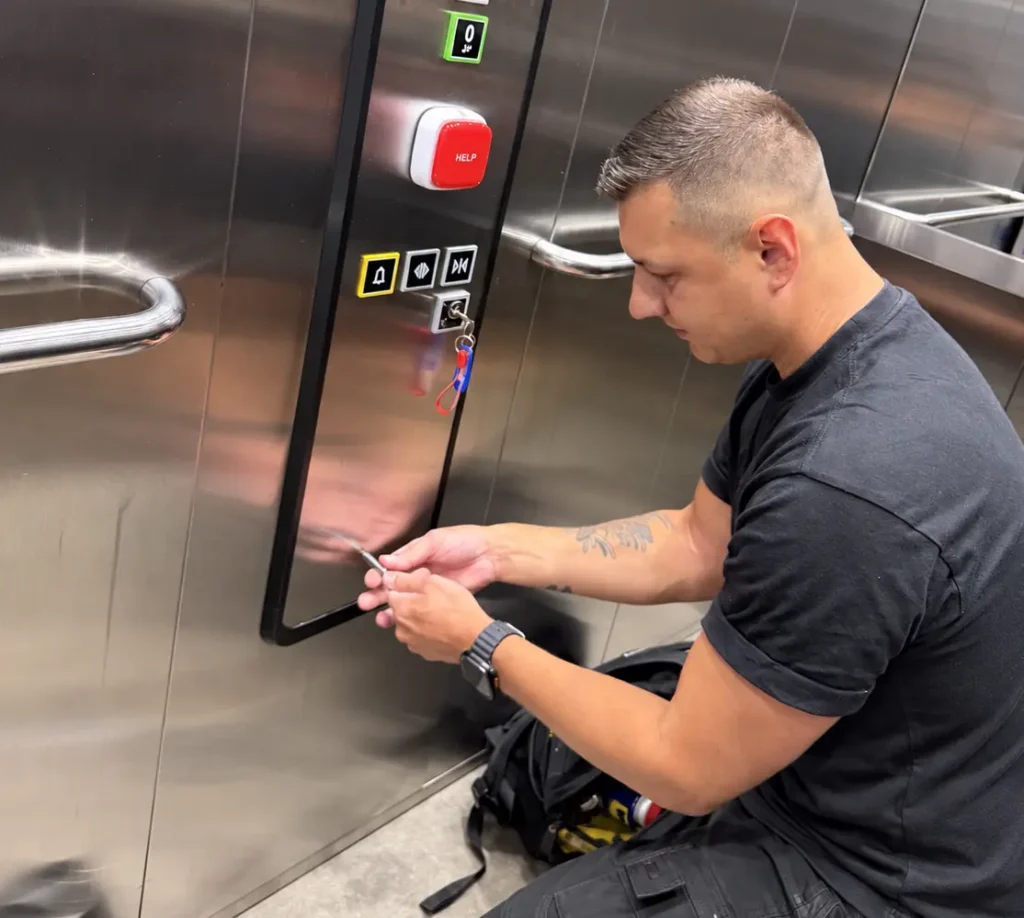
When your maintenance engineer arrives, be available to brief them directly. Walk them through what you observed, any information from trapped passengers if applicable, the sequence of events before the fault, and any error codes or warning lights you noticed.
Give the engineer unobstructed access to all areas they need, including the machine room, lift pit and all landings. Do not attempt to assist or supervise the repair beyond what the engineer asks of you.
Once the engineer has assessed the fault they will advise you on one of three outcomes. The fault can be resolved immediately and the lift returned to service. The fault requires parts or further work and the lift will remain out of service for a defined period. The lift has developed a condition that requires it to remain out of service pending a formal LOLER thorough examination before it can legally be returned to use.
In each case, get the engineer’s findings and recommended actions in writing. This is both your maintenance record and your evidence of due diligence.
Step 7: Document Everything
Throughout the incident, maintain a written record. This does not need to be complex. A simple log noting the time the fault was reported, who reported it, the actions taken and by whom, the time the engineer was called, the engineer’s arrival time, the fault identified, the action taken and the time the lift was returned to service is sufficient.
This record serves several purposes. It demonstrates that the building manager responded promptly and appropriately. It provides the factual basis for any SLA review of your maintenance contract. It forms part of the building’s compliance record under LOLER. And if any injured party subsequently makes a claim, it provides contemporaneous evidence of how the incident was managed.
Store the record with your other lift documentation including your LOLER examination reports and service records. For buildings with frequent lift issues, a running incident log is useful for identifying patterns and making the case for more frequent maintenance visits or equipment replacement.
Reducing the Risk of Future Breakdowns
A lift breakdown is always disruptive. The most reliable way to reduce frequency and severity is through a well-structured planned maintenance programme.
Regular planned preventative maintenance identifies developing faults before they cause failures, keeps safety systems operating correctly and ensures the equipment is maintained in the condition required by PUWER. Buildings on a comprehensive maintenance contract consistently experience fewer unplanned outages and lower overall maintenance spend than those relying on reactive repair alone.
If your lift has experienced repeated breakdowns, it may be worth discussing with your maintenance engineer whether the frequency of visits is appropriate for the usage level, whether the lift is approaching end of life and would benefit from modernisation or refurbishment, or whether a component that is repeatedly failing should be proactively replaced rather than repaired each time it fails.
For older lifts with recurring faults, our guide to when lift repairs stop being cost effective is worth reading before your next engineer visit.
When to Consider Switching Maintenance Provider
A lift breakdown can also be a prompt to review whether your current maintenance provider is meeting the standards your building requires. If callout response times are consistently slower than your contract specifies, if faults are recurring without resolution, or if service reporting is inadequate, switching to a provider better suited to your needs is a legitimate response.
Our guide to how to switch lift maintenance provider covers how to exit your current contract, what to look for in a new provider and how to manage the handover without creating a compliance gap.
How Deltron Can Help
Deltron provides 24/7 emergency lift breakdown and repair services across the UK for all lift types and brands, including lifts we did not install. Our engineers are experienced in attending emergency callouts quickly, diagnosing faults accurately and getting lifts back into safe operation with minimum disruption.
If your lift is currently out of service, contact our emergency team now or call 0330 124 2169.
If you would like to review your maintenance contract to reduce the risk of future breakdowns, request a maintenance proposal from our team.
Frequently Asked Questions
What should I do first if a lift breaks down in my building?
Your first priority is to establish whether anyone is trapped inside the lift. If someone is trapped, call your maintenance provider’s emergency line immediately and maintain verbal contact with the person until help arrives. Do not attempt to open the doors manually. If you cannot reach your maintenance provider, call 999.
Can I reset the lift myself if it breaks down?
Only if you have been specifically trained and authorised to do so by your maintenance provider. Attempting to reset a lift without proper knowledge of the fault can mask the underlying problem, create a safety risk or invalidate a warranty or insurance claim. If in doubt, wait for the engineer.
How quickly should an engineer arrive for an emergency lift callout?
This depends on your maintenance contract. Most contracts specify a response time for emergency callouts, typically between two and four hours. Check your contract for the specific commitment. If your provider is consistently missing their contractual response times, this is grounds for reviewing your agreement.
What are my legal obligations when a lift is out of service?
You have a duty of care to all building occupants, a heightened obligation to disabled occupants under the Equality Act 2010, and responsibilities under LOLER not to return a lift to service until it has been confirmed safe by a competent person. You should also check your building’s emergency evacuation plan if any occupants rely on the lift for safe exit.
Do I need to report a lift breakdown to anyone?
If anyone was injured as a result of the breakdown, consider whether the incident is reportable under RIDDOR. If the lift has developed a fault that indicates it may not be safe, you should not return it to service until a competent person confirms it is safe, and in some cases the examiner is required to notify the HSE. Check your insurance policy for any notification requirements.

